Saturday, June 7, 2014

"But there's nothing I can do about it now………"


Last training ride near Silver City, was in the area for work and got in 60 miles, mostly after dark, this ride was so nice, one for the memory files...
 
Come and follow along:
If you are reading this blog you probably have these links but here they are if needed

2014 Tour Divide SPOT Location Tracker Info
You can follow the overall race here:
http://trackleaders.com/tourdivide14

2014 Audio Recordings from the Racers
http://mtbcast.com/site2/tour-divide-2014/

You can follow my individual spot tracker here:

You can follow/read and make race related comments here:
http://www.bikepacking.net/forum/index.php?topic=6102.0
(note: find the ‘new’ 2014 TDR thread –always started once the race actually kicks off)


"I've got a long list of real good reasons
For all the things I've done……….
And I know just what I'd change if went back in time somehow
But there's nothing I can do about it now………"
                         Willie Nelson, Nothing I Can Do About It Now

Working thru the final checklist, second guessing gear choices, getting ready to box up the ol dragon bike and hop on the plane to Banff in a couple of days……….

Time to get centered, to find the right mental balance, to let the hype, excitement and also the doubts and worries fade into the back ground.
 
And time to say thank you Sharon for all you do.....

Time to go quite and get focused, might get in one more post but then it will be time to say---See ya on the other side........

Saturday, May 31, 2014

Less fear

the Carver Ti 29er dragon bike rides again
Race Strategy(s)
There a numerous race strategy’s for the TDR.  And they tend to go hand in hand with the various bike and gear selections.  Having completed the 2010 TDR my thinking has evolved a bit.  When I look back I realize I spent much of my time in 2010 worrying about what ‘might’ happen.  
 ya baby, my new jersey from LBS

Well what might happen ‘might’ but most likely ‘won’t’.   

So for 2014 I have chosen gear and an overall strategy focused on fear reduction. 
 
·         I will make better & more ‘race focused’ (and fewer ‘comfort focused’) choices as the race unfolds.
 
·         I will stop less overall and be more effective when I do.

·         I will maintain the best pace I can but will not overextend myself on climbs.

·         Within reason I will not let rain, or distant rain clouds, dictate my saddle time or end of day.

·         I will not routinely over supply or carry to much water.

·         I will camp more but with a more resilient sleep system.
·         I will ride longer but may stop more often at the opportunities for real food. (Note to self: do not over eat real food except at the end of the day)

·         I may take more power naps rather than always try to caffeine my way through.

·         I will not carry to many superfluous repair parts and extra clothing. Or have tires and drivetrain items unnecessarily replaced.

·         I hope to sometimes ride with other racers.  But will not automatically lock into someone else’s pace or schedule. (note: this is a complex topic so please don’t read too much into my abbreviated comments)

In short I will endeavor to apply the lessons I learned in 2010 to race smarter and harder.  And along the way I hope/plan to finish faster yet enjoy the overall experience even more.
 

Dragon bike is ready to get down to it


Thursday, May 29, 2014

Training Taper for the TDR?

Boreas Pass May 29th

I hope to get in at least 4-6 additional ‘easy to moderate’ 25 to 70 mile rides between now and when I hop on the plane. Actually I would do quite a bit more but unless I want to ride late at night my time/work will not allow.

But this brings me to questions about tapering before the big event.  I don’t think classic taper protocol means much if anything for the TDR.  Sort of along the same line as training for a classic race-fitness ‘peak’ means little for the TDR.  The long TDR is different enough from shorter races that much of what works so well for those shorter/max effort races doesn’t translate 100%.  A strong base fitness directly translates, but I question if a classic peak or a typical 1-2 week taper means anything for the TDR.

In 2010 I was very concerned about ‘starting slow’ during the first few days so I got in some truly hard riding on the day I departed for Banff and once more on the drive up.  Worked well as I got a great start and did not need to ‘ease into’ the big miles.  I hit the ground running; I felt my body was still fully acclimated to the ‘hard push’ with no lag ramping back up.

Because I am flying to Banff this time around and what with boxing up the bike and such I will not be able to replicate my 2010 routine.  So I plan to approach my first 3 days TDR days a bit differently.  Basically I hope to use a little more ‘soft pedal’ early on but yet try to extend the actual time in the saddle. 

Ya, Ya, I know--It’s all just mental gymnastics at this late date, but hey it gives me something to distract myself with.

More off topic pictures for this blog episode:
I had to be in Silverthorne CO for work and afterwards had the chance to ride the TDR route from Frisco to about 1/3 the way up Boreas Pass.  Just an easy spin of about 25 miles on bike path and up a gentle ‘railroad grade’ climb.
Boreas Pass is still closed to motorized vehicles but pretty dry up to about 10,700ft where I had to turn around due to time.

Tuesday, May 27, 2014

Elevation and Food


Food is the second most important item on the TDR.  (In case you are wondering--First is ‘body’, Second is ‘food’ and Third is 'bike') 

If your body breaks you are basically done as a racer, as once broken you probably not going to be able to fix yourself in a reasonable amount of time.  This is why body is 1st. You might still finish but likely nowhere near your best time.
On the other hand if your bike breaks you have a good chance to get going again without losing to much time. hence bike is 3rd. (Then again break it in the wrong way/spot and you could lose days)
Which brings us to #2, food.  Sure you can skimp or miss some food here and there.  But bad things tend to happen if you run out or believe you have to ‘conserve’.  You slow way down and mentally it gets truly tough.  Miss enough meals or play to much 'must conserve' game and the lost time piles up.  And time lost is never to be found.  Again you can finish, but doubtless it will be at slower time than anticipated.

But how do food and elevation profiles go together?  Simple, to get to the next food, in a timely manner, you have to complete the elevation.  IE: get to the small little store 1 hr after it closes and you could lose hours.  Make this mistake several times and you could lose a day or so.
I will carry a GPS for navigation, and while the GPS and my I-Phone have maps I will not really use them much, if at all.  Virtually all my food & logistics planning will come from memory and simple profile sheets.  This is the same basic approach I used with good success in 2010.  Back then I never needed a ‘map’ per say.  In 2010 I was working off of study, memorization and also used slightly more detailed profile chart(s).  This time around I will carry simpler profile charts, they just show mileage, elevation and key re-supply points.  The elevation and miles tell me how soon I can expect hit the next marker(s).  A 'red line' marker could mean several 'critical' things, could be 24hr access or just better “look/plan ahead” up to the next guaranteed re-supply point.  IE: From here what do I have to purchase to make the next ‘red’ marker if the blues will be closed or water only? Blue basically means things like limited hours, just water or ‘maybe I do, maybe I don’t’ re-supply there.  Dashed means might be closed etc.
When I am exhausted and not thinking straight and trying to decide how much to buy/carry, I will pull out these profiles.  No telling where I will be at any given time.  So as I re-supple in that slightly incoherent ‘here and now’ I can insure I will have enough to reach the next red line or perhaps a blue line during normal business hours.  I also will study them at night and ‘plan’ the following day. 

Simple and easy for the befuddled mind.  Yet little wasted time poring over maps or pestering strangers or fellow TDR racers for re-supply info.

Monday, May 26, 2014

Noisy Training Ride

Today we went on a training ride on the path that goes through the Air Force Academy.  We were treated to a show by the Thunderbirds.  Not sure if they were practicing for graduation or if they were doing a memorial day program.
 They sometimes came in low and caused quite the noise.

Click on this link for their performance schedule

Sunday, May 25, 2014

Memorial Day Post

(I am a Thankful Vet who gets to race the divide)

OUR MISSION

To help reintegrate traumatically combat-injured U.S. veterans and active service members from recent wars into society by building hope and resilience, facilitating camaraderie, and providing security and serenity through fly fishing and other high quality therapeutic recreational mediums in southwest Montana
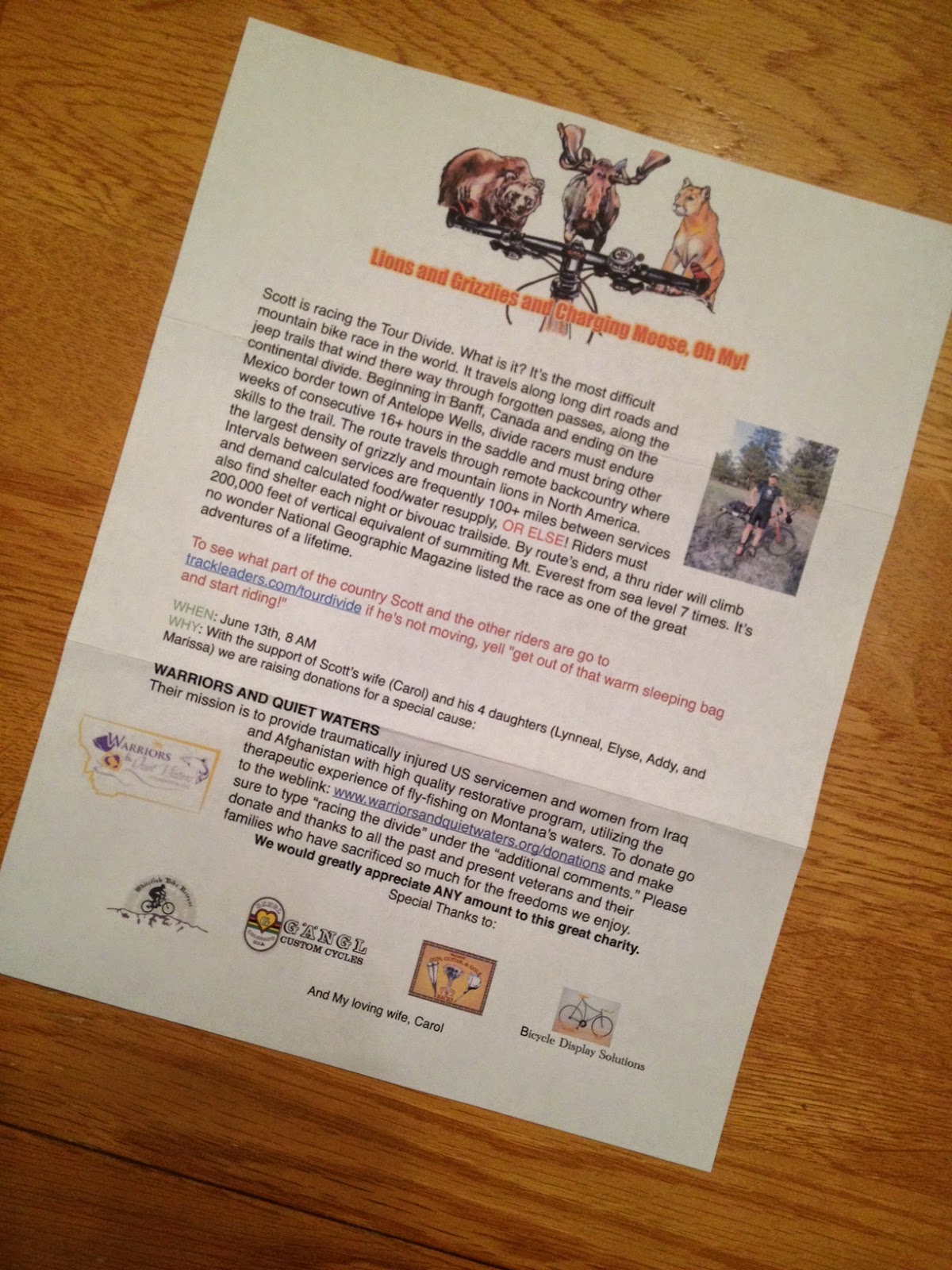
Scott Williams, a rookie TDR racer with a strong road racing background and one who has the tools to race at the tip of the 50 yr-old+ group has asked a favor of me. 

Scott (with the help of his wife & daughters), like many TDR racers is raising money for a charitable cause and has invited me to participate in their efforts. 
 
Every cause that fellow TDR racers are raising money for seem worthy.  But this one hits a wee bit closer to home than many.
 
I don’t normally ask others to contribute or make donations. Usually I follow the ‘anonymous’ path in these matters. 
 
However, as a Vet this one does hit close enough to home that I am asking you -- any & all family, friends or fellow TDR racers who read my blog to seriously consider a donation to Scott’s cause!

Details:
Just follow the link to the Warriors and Quite Waters Foundation, go to the donation page and follow the drill.
Hey, be sure to type “racing the divide" under the "additional comments” box.

Thanks in advance and have a great Memorial Day!!

Friday, May 23, 2014

Running Cool on the TDR

just added a simple & light insulated slip cover
 
I have been meaning to do this for a while, and considering the time line I guess it’s now or never.  I’ve used this same trick many times and also back in 2010.  I have found I can make a 2.5L mix of ice/water (or my favorite TDR energy/drink,-ice/pepsi) stay ice cold till it’s used up.  Sometimes there is enough ice left to cool more water from a warm external refill.  May not mean much in Montana but a insulated bladder could be quite nice to have come NM’s hot dusty sections.  Hey every little thing helps and I am tempted to drink more/better when it’s ice cold
Also the slick aluminized cover makes it easier to slip the bladder into the frame bag and reduces the chances of the zipper snagging the soft plastic.

Side note:  Feel the anxiety yet?
Am I, and a small handful of others, the only TDR racers who update their blog???
I just went thru all the blogs on the signup list and almost no one is adding to their blogs--come on I need more distracting reading materials over the next two weeks to keep me from climbing the wall ....